

Versión en inglés disponible líneas abajo
Autores: Claudia Zúñiga, Nicole Gomez, César Gamboa
- Una sociedad civil con múltiples agendas y una agenda climática inconclusa
El cierre de la COP 31 se ha convertido, para muchos, en una sesión prolongada con resultados altamente desalentadores, en la que los Estados parte ya no lograron ponerse de acuerdo. El contexto geopolítico, el incremento de guerras en varias regiones del mundo y los estragos del Fenómeno del Niño son elementos humanos y naturales para los que la agenda climática no está preparada.
Derecho, Ambiente y Recursos Naturales (DAR) viene asistiendo a la COP de Cambio Climático y a los procesos de negociación desde hace dos décadas, en alianza y en redes con organizaciones de la sociedad civil y con organizaciones indígenas, por lo que creemos que vale la pena evaluar nuestro rol como parte de la sociedad civil y definir hacia dónde van las acciones y la articulación de las ONGs frente a una crisis climática que mantiene en jaque a Latinoamérica y el Caribe. La experiencia en esta última COP en Antalya, Turquía, muestra que la sociedad civil se ha ubicado en tres círculos muchas veces desconectados de una gran articulación para la incidencia climática, y de la actuación de grupos y agendas que en paralelo se desarrollan y que podrían incluso llegar a interferir unas con otras. El primer círculo, el más duro y especializado, reúne a las ONGs enfocadas en las “negociaciones” para promover las propuestas de la sociedad civil en el texto, mandatos y burocracias de las propias COPs. El segundo círculo lo forman otras ONGs y algunos think tanks que colaboran con el primero, pero que tienen una agenda independiente con respecto a las decisiones climáticas y no necesariamente se involucran en la negociación; están trabajando de manera satélite a la negociación y a las instituciones de Naciones Unidas, y otras organizaciones e iniciativas internacionales que colaboran en la implementación de la agenda climática. El tercer círculo agrupa a las ONGs que participan en las COPs a través de side events en los pabellones de países o en la Green Zone, pero cuyo objetivo es el posicionamiento de las distintas propuestas en las que trabajan y hacer networking en función de dichas propuestas, incluso la búsqueda de fondos. Paralelamente se producen actividades fuera del espacio oficial, en eventos paralelos, en la Cumbre de los Pueblos, en universidades, hoteles u otros espacios, que pueden tener agendas de convergencia o de presión a través de campañas y movilizaciones.
Enfrentar la crisis climática exige acciones conjuntas. Pero ¿cómo avanzar en consensos cuando los resultados de esta COP demuestran una voluntad política cada vez más fragmentada? La falta de ambición en la COP 31, se evidenció en la copresidencia de Turquía y Australia, se hizo evidente con la ausencia de Estados Unidos y el bloqueo de algunos países para lograr consensos. Las negociaciones omitieron por completo el fallo de la opinión consultiva de la Corte Internacional de Justicia del 2025 sobre el riesgo global del cambio climático (CANLA, 2026). Rusia y Arabia Saudí encabezaron el bloque que rechazó mencionar de forma explícita el abandono de los combustibles fósiles. Los temas de adaptación, transición justa y financiamiento fueron inconclusos y se postergaron para la próxima COP (Etiopía). Los Bancos Multilaterales de Desarrollo (BMD) también generaron cuestionamientos. Aunque en 2025 destinaron $100 billones de dólares al financiamiento climático, organismos como el Banco Mundial (BM) y el Banco Interamericano de Desarrollo (BID) están eliminando sus planes de acción climática, lo que pone en duda sus compromisos de alineación con el Acuerdo de París de 2015. En los distintos temas, esta COP de Antalya fue un espacio de debate inconcluso que olvidó la urgencia de la toma de decisiones e implementación. Parece que las negociaciones necesitan salir de su zona de confort, al igual que sus actores, quienes siguen postergando asumir su responsabilidad frente al calentamiento global.
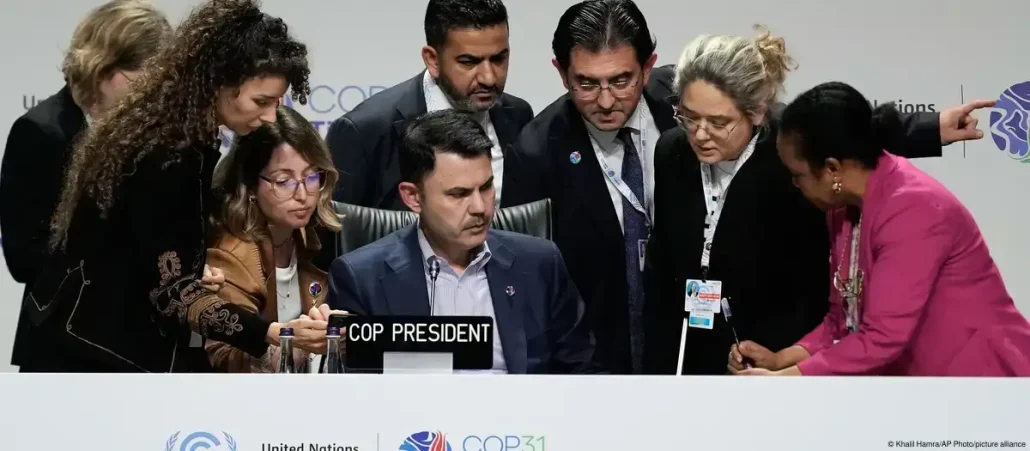
Foto: Khalil Hamra/AP Photo/picture alliance
- Financiamiento climático directo a pueblos indígenas
Parte de la agenda climática de las organizaciones indígenas y sus aliados a nivel global es que sean beneficiarios y participantes de los mecanismos que se diseñan para conservar los bosques como una forma de luchar contra el cambio climático. Desde DAR hemos colaborado en esta agenda desde hace años, así como hemos apoyado una colaboración más integral entre las organizaciones indígenas andinas y amazónicas, a través de la Plataforma de pueblos indígenas frente al cambio climático en el Perú. Este apoyo se ha venido realizando desde la creación del Pacto de Unidad (2007), en el proceso de aprobación de la ley marco de cambio climático y de consulta previa de su reglamento (2018 y 2019). En ese sentido, seguiremos apoyando este tipo de plataformas de coordinación de las organizaciones indígenas, ya que su articulación puede fortalecer sus propuestas que vayan incluso más allá de la agenda climática, sino que abarquen todas las políticas públicas que les afecten o beneficien.
En ese sentido, las oportunidades para un financiamiento directo hacia las comunidades se basan en fortalecer el rol decisor de su propio destino, de su propia autodeterminación, considerando un enfoque de género y el rol que desempeñan a nivel comunitario y organizativo. Sin embargo, un gran reto es cómo su rol de gestor y administrador de fondos debe balancearse con otros roles que asumen las organizaciones indígenas, como la representatividad de los intereses de las comunidades y el carácter fiscalizador y la demanda de rendición de cuentas de las políticas de Estado.
Un segundo reto del nuevo modelo de gobernanza de los fondos climáticos, no solo del financiamiento directo para las comunidades, sino también para los mecanismos generados a nivel global, como los de los Estados, vinculantes o voluntarios, es dotarlos de transparencia para asegurar la efectividad de estos fondos, es decir, para que estos fondos lleguen directamente a las comunidades. Lo importante es asegurar que la opacidad no afecte a esta oportunidad que las comunidades tienen para reducir los costos de intermediación e incrementar los potenciales beneficios de los fondos climáticos. Asegurar los resultados implica que exista transparencia desde los donantes hasta las propias organizaciones indígenas que administran los fondos y sus impactos.
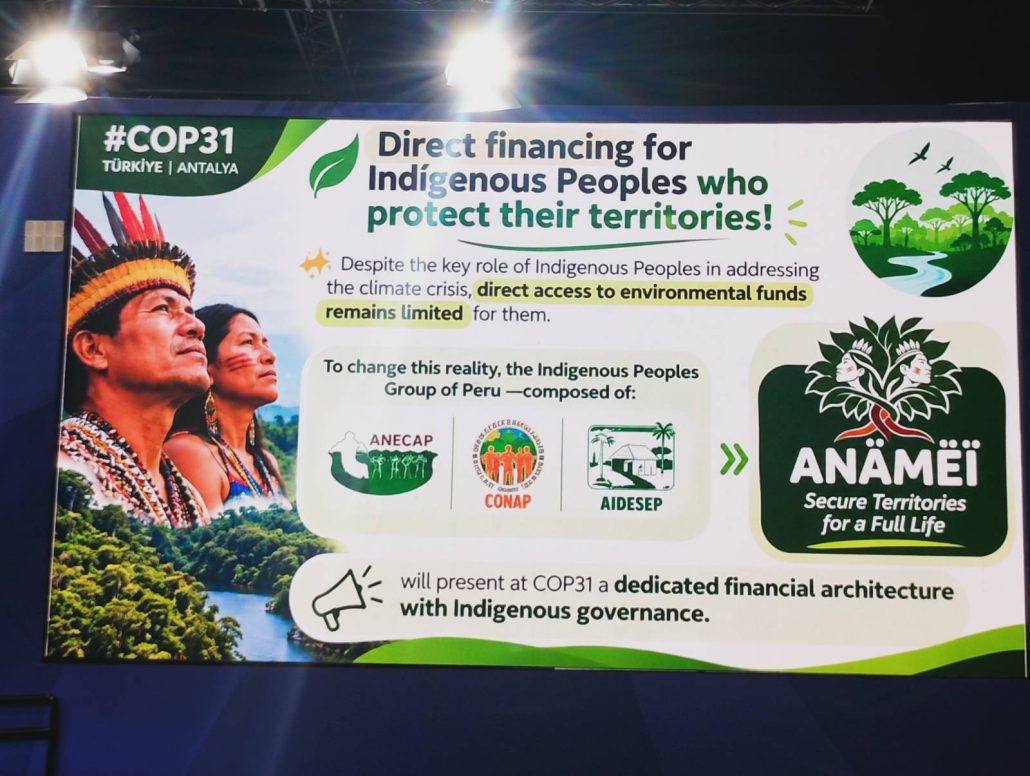
Foto: César Gamboa/DAR
- Bosques y financiamiento climático
En la Cumbre de Líderes de la COP 31 “Bosques y acción climática: la contribución de los bosques para hacer frente al cambio climático”, se centró en transformar los compromisos políticos en acciones concretas para detener y revertir la deforestación y la degradación forestal de aquí al 2030 (UNFCCC, 2026), donde se posicionaron Lula, las organizaciones indígenas, el FCLP, y los mensajes políticos optimistas de obtener un mayor financiamiento, frente a la poca ambición de la propia COP 31 (FCLP, 2026). Además, los líderes de Brasil, Guyana, Noruega, Países Bajo, El Congo y Reino Unido, consideran importante el objetivo forestal para el 2030 basado en la Declaración de los Líderes de Glasgow sobre los Bosques y el Uso de la Tierra de la Asociación de Líderes sobre Bosques y Clima, y los resultados de la COP 30 en Belém (incluyendo el Mecanismo para los Bosques Tropicales —“Tropical Forest Forever Facility” TFFF— y los compromisos sobre la tenencia de la tierra).
Aún existe el interés de seguir contribuyendo con la transparencia en el financiamiento forestal de varios países como Noruega y Gran Bretaña. En el caso de Brasil, destacó su mensaje de haber logrado una reducción del 70 % en la deforestación de la Amazonia entre 2022 y 2026, así como también la restauración de 4,5 millones de hectáreas de suelo y los avances en el Mecanismo para los Bosques Tropicales, que ha movilizado 7.800 millones de dólares. Ciertamente fue un acto político que abrigaba esperanza de lograr la meta de obtener un mayor financiamiento para la conservación de los bosques tropicales; sin embargo, los retos de un sistema de gobernanza y mayor transparencia aún parecen ser insuperables para este tipo de iniciativas que pretenden tener un alto impacto en un corto tiempo.
Asimismo, en el marco de las negociaciones de la COP 31, surgió el interés por “acelerar la captura, utilización y almacenamiento de carbono hasta alcanzar, como mínimo, 500 MtCO₂ para el año 2035, y a trabajar para alcanzar entre 1,3 y 2,5 Gt de CO₂ al año para el año 2035” (Climate tracker LATAM, 2026). Si bien estas tecnologías se presentan como una alternativa climática al retener las emisiones de sectores altamente contaminantes bajo tierra, su verdadera eficacia genera escepticismo. De hecho, incluirlas en un documento de la COP recibió duras críticas por priorizar la continuidad de las actividades contaminantes en lugar de impulsar soluciones basadas en energías limpias (Climate tracker LATAM, 2026).
Foto: AIDESEP
- Transición energética: el mecanismo BAM
No se contó con consenso por parte de los países para implementar la gobernanza o el funcionamiento del Mecanismo Belém-Antalya (BAM), el cual se organiza en tres instancias: Entidad de coordinación, Generación de conocimiento, Acción y Soporte técnico; esta última sería la encargada de negociar y gestionar el financiamiento. Por ello, el BAM queda postergado para negociaciones en el año 2027, este proceso inicia desde este año para que los Estados envíen sus posiciones e insumos para marzo y sean discutidos en las sesiones del SB66.
Una de las grandes expectativas para el BAM era contar con financiamiento directo, pero la Unión Europea, Reino Unido, Canadá y Japón no estuvieron de acuerdo sobre la creación de fondos específicos y una estructura. A su vez, plantean que la Transición Energética debería aplicarse a todos por igual, desconociendo las responsabilidades diferenciadas entre países del Norte y Sur Global.
La presidencia de la COP 31 eliminó toda mención sobre abandono progresivo de combustibles fósiles y carbón. Ante ello, 130 países rechazaron el acuerdo. Por ello, ante la falta del consenso sobre el BAM, la meta 35×35 sobre electrificación no quedó plasmada en el acuerdo final; ya que solo implica ampliar la electrificación al 35% para 2035; sin incluir el abandono progresivo de gas, petróleo y carbón; a su vez, la demanda de litio, cobre, níquel y cobalto se multiplicaría hacia 2040, debido a su rol primordial en dicha industria, ello es un riesgo para los países productores y exportadores de commodities.
Cabe destacar que en la decisión formal adoptada sobre el Programa de Trabajo de Transición Justa (JTWP), la frase “minerales críticos” fue incluida por primera vez en la historia en una decisión oficial de la COP (en la COP30 de Belém había estado en borradores, pero se había caído). Ningún país se opuso con fuerza; esta vez, China lo apoyó. Aunque el concepto de minerales críticos logró entrar al texto formal, los países negociadores eliminaron la cláusula de debida diligencia obligatoria en derechos humanos a lo largo de sus cadenas de suministro.
Enlgish
An Introspective Assessment of the COP 31 Climate Change Conference: Still No Commitment in Sight
Claudia Zúñiga, Nicole Gomez, César Gamboa
- A Civil Society with Multiple Agendas and an Unfinished Climate Agend
For many, the conclusion of COP 31 has proven to be a protracted session with deeply discouraging results, as the participating states failed once again to reach an agreement. The geopolitical landscape, the rise in conflicts across various regions of the world, and the devastation wrought by the El Niño phenomenon represent human and natural factors for which the current climate agenda is ill-prepared.
For two decades, *Derecho, Ambiente y Recursos Naturales* (DAR)—Law, Environment, and Natural Resources—has participated in the UN Climate Change Conferences (COPs) and their associated negotiation processes, working in partnership and networks with civil society and Indigenous organizations. We believe it is essential to evaluate our role within civil society and to define the future direction of our actions and the coordination among NGOs, especially as the climate crisis continues to pose a critical threat to Latin America and the Caribbean. Our experience at this latest COP in Antalya, Turkey, reveals that civil society has organized itself into three distinct spheres—spheres that often lack the cohesion necessary for effective climate advocacy. Furthermore, various groups and agendas are operating in parallel, at times even potentially interfering with one another. The first sphere—the most rigorous and specialized—consists of NGOs focused on the formal «negotiations,» working to integrate civil society proposals into the official texts, mandates, and bureaucratic frameworks of the COP process itself. The second circle consists of other NGOs and certain think tanks that collaborate with the first group but maintain an independent agenda regarding climate-related decisions; they do not necessarily engage directly in the negotiations. Instead, they operate as satellites to the negotiation process, the United Nations institutions, and various other international organizations and initiatives that contribute to implementing the climate agenda. The third circle comprises NGOs that participate in the COPs through side events—held in national pavilions or the «Green Zone»—with the primary goal of promoting their specific proposals and networking to advance those initiatives, which often includes seeking funding. Concurrently, activities take place outside the official venue—in parallel events, at the «Peoples’ Summit,» or in universities, hotels, and other locations—often focused on building consensus or exerting pressure through campaigns and mobilizations.
Addressing the climate crisis requires collective action. Yet, how can consensus be reached when the outcomes of this COP reveal an increasingly fragmented political will? The lack of ambition at COP 31—underscored by the co-presidency of Turkey and Australia—was further highlighted by the absence of the United States and the obstructionist stance taken by certain countries to prevent consensus. The negotiations completely overlooked the 2025 advisory opinion from the International Court of Justice regarding the global risks posed by climate change (CANLA, 2026). Russia and Saudi Arabia led a bloc that rejected any explicit mention of phasing out fossil fuels. Discussions on adaptation, a just transition, and financing remained inconclusive and were deferred to the next COP (in Ethiopia). Multilateral Development Banks (MDBs) also drew criticism. Although $100 billion was allocated for climate finance in 2025, institutions such as the World Bank (WB) and the Inter-American Development Bank (IDB) are phasing out their climate action plans—a move that casts doubt on their commitments to align with the 2015 Paris Agreement. Across various topics, this COP in Antalya served as a forum for inconclusive debate, failing to address the urgent need for decision-making and implementation. It appears that the negotiations—and the actors involved—need to step out of their comfort zones, as they continue to defer taking responsibility for addressing global warming.
Photo: Khalil Hamra/AP Photo/picture alliance
- Direct climate finance for Indigenous peoples
A key component of the climate agenda championed by Indigenous organizations and their global allies is ensuring that Indigenous peoples become both beneficiaries of and participants in the mechanisms designed to conserve forests as a strategy to combat climate change. At DAR, we have supported this agenda for years; we have also fostered more comprehensive collaboration between Andean and Amazonian Indigenous organizations through the Platform of Indigenous Peoples on Climate Change in Peru. This support has been ongoing since the inception of the “Pacto de Unidad” (Pact of Unity) in 2007, throughout the process of approving the framework law on climate change and the prior consultation process for its regulations (2018 and 2019). In this regard, we will continue to support such coordination platforms for Indigenous organizations, as their collective engagement can strengthen proposals that extend beyond the climate agenda to encompass all public policies that affect or benefit them.
In this context, opportunities for direct funding to communities are rooted in strengthening their role in deciding their own future—their own self-determination—while incorporating a gender perspective and recognizing the roles they play at both the community and organizational levels. A major challenge, however, lies in balancing their role as fund managers and administrators with the other functions Indigenous organizations perform, such as representing community interests, exercising oversight, and demanding accountability regarding state policies.
A second challenge for the new governance model for climate funds—not only concerning direct funding for communities but also regarding mechanisms established at the global or state level, whether binding or voluntary—is ensuring transparency to guarantee the effectiveness of these funds; that is, ensuring that the resources reach the communities directly. It is crucial to prevent a lack of transparency from undermining the opportunity communities have to reduce intermediation costs and maximize the potential benefits of climate funds. Ensuring positive outcomes requires transparency throughout the entire chain—from the donors down to the Indigenous organizations themselves, which manage the funds and oversee their impacts.
Photo: César Gamboa/DAR
- Forests and Climate Finance
The COP 31 Leaders’ Summit, titled “Forests and Climate Action: The Contribution of Forests to Addressing Climate Change,” focused on transforming political commitments into concrete actions to halt and reverse deforestation and forest degradation by 2030 (UNFCCC, 2026). The event featured contributions from Lula, Indigenous organizations, and the Forest and Climate Leaders’ Partnership (FCLP), alongside optimistic political messaging regarding the prospect of securing increased funding—a stance that stood in contrast to the limited ambition displayed by COP 31 itself (FCLP, 2026). Furthermore, leaders from Brazil, Guyana, Norway, the Netherlands, Congo, and the United Kingdom underscored the importance of the 2030 forest target, drawing upon the Glasgow Leaders’ Declaration on Forests and Land Use—spearheaded by the Forest and Climate Leaders’ Partnership—as well as outcomes from COP 30 in Belém (including the “Tropical Forest Forever Facility” (TFFF) and commitments regarding land tenure).
Several nations, such as Norway and Great Britain, remain committed to fostering transparency in forest-related financing. Brazil, for its part, highlighted its achievement of a 70% reduction in Amazonian deforestation between 2022 and 2026, the restoration of 4.5 million hectares of land, and progress on the Tropical Forest Forever Facility, which has mobilized $7.8 billion. This was, in essence, a political initiative rooted in the hope of meeting the goal of securing greater funding for the conservation of tropical forests. However, the challenges related to a governance system and greater transparency still appear insurmountable for initiatives of this kind, which aim to achieve a high impact within a short timeframe.
Furthermore, in the context of the COP 31 negotiations, interest emerged in “accelerating carbon capture, utilization, and storage to reach at least 500 MtCO₂ by 2035, and working toward achieving between 1.3 and 2.5 Gt of CO₂ per year by 2035” (Climate Tracker LATAM, 2026). While these technologies are presented as a climate alternative—by sequestering emissions from highly polluting sectors underground—their true effectiveness is met with skepticism. In fact, their inclusion in a COP document drew sharp criticism for prioritizing the continuation of polluting activities rather than promoting solutions based on clean energy (Climate Tracker LATAM, 2026).
Photo: AIDESEP
- Energy Transition: The BAM Mechanism
There was no consensus among countries regarding the implementation of the governance or operational structure of the Belém-Antalya Mechanism (BAM). The mechanism is organized into three components: a coordination entity, knowledge generation, and action and technical support—the latter being responsible for negotiating and managing financing. Consequently, the BAM has been deferred to the 2027 negotiations; this process begins this year, with states invited to submit their positions and inputs by March, to be discussed during the SB66 sessions.
One of the major expectations for the BAM was the provision of direct financing; however, the European Union, the United Kingdom, Canada, and Japan did not reach an agreement regarding the creation of specific funds and a structure. At the same time, they proposed that the Energy Transition should apply to everyone equally, disregarding the differentiated responsibilities between countries of the Global North and the Global South.
The COP 31 presidency removed any mention of the phase-out of fossil fuels and coal. In response, 130 countries rejected the agreement. Consequently, due to a lack of consensus, the «35×35» electrification target—which entails expanding electrification to 35% by 2035—was not included in the final agreement, as it did not incorporate the phase-out of gas, oil, and coal. Furthermore, the demand for lithium, copper, nickel, and cobalt is projected to multiply by 2040, given their essential role in this industry—a development that poses a risk to countries that produce and export these commodities.
It is worth noting that in the formal decision adopted regarding the Just Transition Work Programme (JTWP), the term “critical minerals” appeared for the first time in the history of an official COP decision (it had previously appeared in drafts for COP30 in Belém, but was subsequently removed). No country strongly opposed its inclusion; in fact, China supported it this time. Although the concept of «critical minerals» made it into the formal text, the negotiating countries removed a clause that would have mandated human rights due diligence throughout supply chains.
References
Climate tracker LATAM, 2026. “El fracaso de Antalya: así fue cómo cayó el texto clave de la COP 31”. https://climatetrackerlatam.org/historias/el-fracaso-de-antalya-asi-fue-como-cayo-el-texto-clave-de-la-cop31/
Climate Action Network América Latina, 2026. El fracaso de la COP 31 no es un accidente, es el síntoma de un sistema en crisis balance de CAN América Latina sobre el cierre de la cumbre en Antalya. https://bit.ly/4eWM06B
FCLP, 2026. Press release: World leaders at COP31 reaffirm their commitment at the highest political level to the global 2030 forest goal. https://forestclimateleaders.org/wp-content/uploads/2026/11/Press-Release_COP31_Leaders-level-event-on-forests_11.11.pdf
UNFCCC, 2026. COP31 Leaders’ Summit Event on Forests. https://unfccc.int/sites/default/files/resource/FINAL%20COP31%20Leaders%E2%80%99%20Summit%20Event%20on%20Forest%20-%20Concept%20Note.pdf